Crypto Security Best Practices: How to Protect Your Digital Assets in 2026
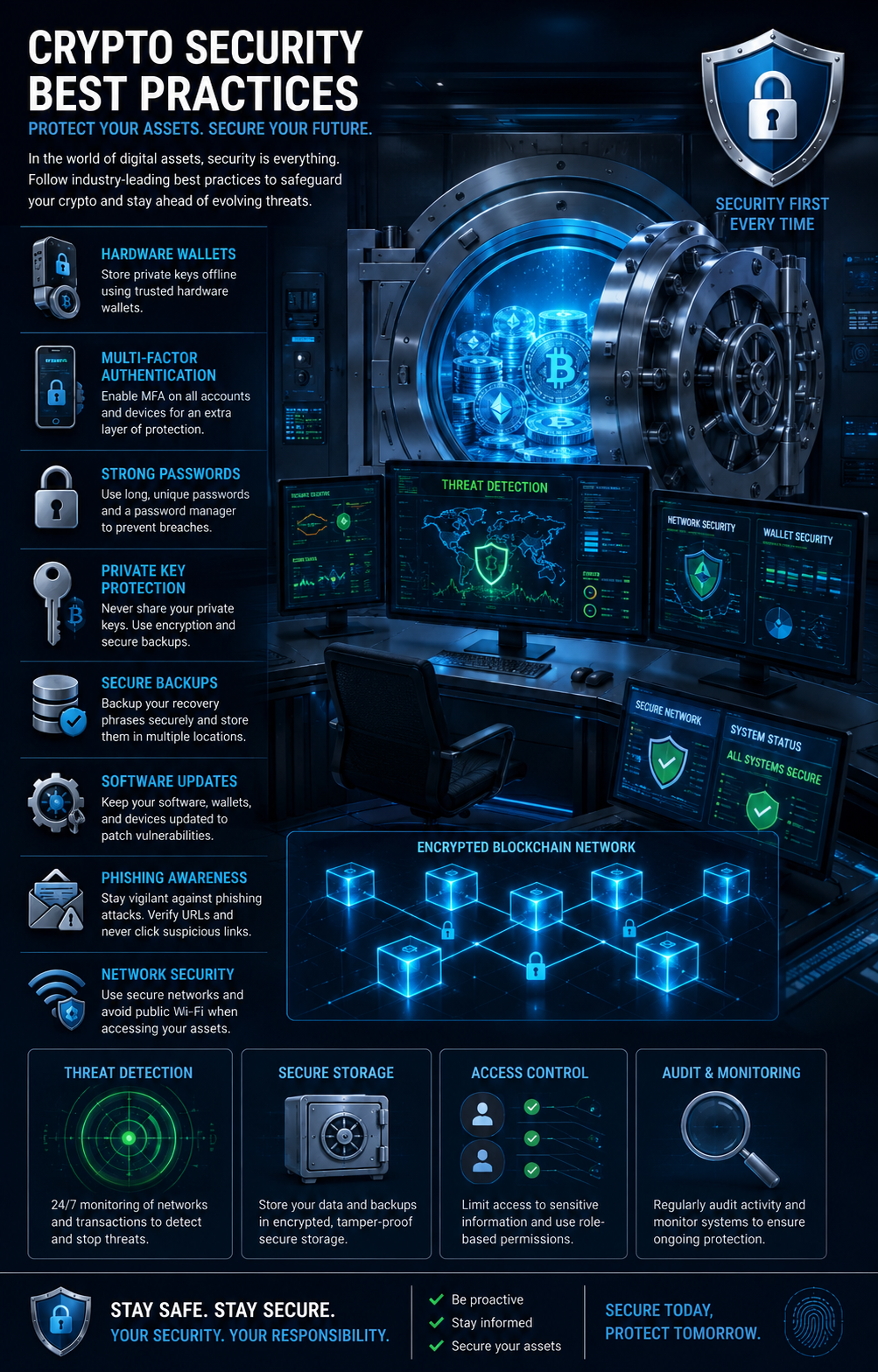
Cryptocurrency adoption continues to grow worldwide as investors, businesses, and institutions embrace blockchain technology. However, as digital assets become more valuable, security remains one of the most important concerns for users. This is why understanding Crypto Security Best Practices is essential for anyone participating in the crypto ecosystem.
Unlike traditional banking systems, cryptocurrency transactions are often irreversible. Therefore, users are responsible for protecting their own funds and private keys. By following proper Crypto Security Best Practices, investors can significantly reduce the risk of theft, scams, and cyberattacks.
In this guide, we explore the most effective Crypto Security Best Practices and explain how users can protect their digital assets in 2026.
Why Crypto Security Matters
The cryptocurrency industry handles billions of dollars in digital assets.
Because blockchain transactions cannot easily be reversed, attackers frequently target crypto users through scams, phishing attempts, malware, and exchange breaches.
Consequently, Crypto Security Best Practices have become a critical part of responsible investing.
Strong security measures help users:
- Protect funds
- Prevent unauthorized access
- Reduce scam risks
- Secure personal information
- Improve long-term investment safety
Therefore, security should always be a top priority.
Understanding Private Keys
One of the most important Crypto Security Best Practices involves protecting private keys.
A private key acts as proof of ownership for cryptocurrency assets. Anyone who gains access to a private key can potentially control associated funds.
Because of this, users should never:
- Share private keys
- Store keys in unsecured locations
- Send keys through email or messaging apps
Instead, private keys should be stored securely and backed up properly.
Use Hardware Wallets
Hardware wallets remain one of the most effective Crypto Security Best Practices available today.
These devices store private keys offline, making them less vulnerable to online attacks.
Benefits include:
- Offline protection
- Enhanced security
- Reduced malware exposure
- Better asset control
As a result, many experienced investors prefer hardware wallets for long-term storage.
Enable Two-Factor Authentication
Two-factor authentication adds an extra layer of protection to crypto accounts.
Even if a password becomes compromised, attackers may still need access to a secondary verification method.
Popular authentication methods include:
- Authentication apps
- Security keys
- Biometric verification
Therefore, enabling two-factor authentication is one of the easiest Crypto Security Best Practices to implement.
Create Strong Passwords
Weak passwords remain a common cause of security breaches.
Users should create passwords that are:
- Unique
- Complex
- Difficult to guess
- Different for every account
Furthermore, password managers can help generate and store secure credentials.
Strong passwords play an important role in Crypto Security Best Practices.
Beware of Phishing Attacks
Phishing attacks are among the most common threats in the crypto industry.
Attackers often create fake websites, emails, or social media accounts designed to steal login credentials.
To avoid phishing scams:
- Verify website URLs
- Avoid suspicious links
- Check official sources
- Confirm communications carefully
Consequently, users should remain cautious whenever interacting with online platforms.
Secure Your Devices
Protecting devices is another essential component of Crypto Security Best Practices.
Users should:
- Install security updates
- Use antivirus software
- Enable device encryption
- Avoid unknown downloads
Additionally, keeping operating systems updated helps reduce vulnerabilities.
Avoid Public Wi-Fi for Transactions
Public Wi-Fi networks may expose users to security risks.
When accessing crypto accounts or conducting transactions:
- Use secure networks
- Consider VPN services
- Avoid sensitive activities on public connections
As a result, users can better protect account information and transaction data.
Verify Wallet Addresses Carefully
Cryptocurrency transactions cannot usually be reversed.
Therefore, users should always verify wallet addresses before sending funds.
Best practices include:
- Double-checking addresses
- Using copy-and-paste carefully
- Confirming recipient information
- Testing with small transactions
These habits help prevent costly mistakes.
Diversify Asset Storage
Another valuable aspect of Crypto Security Best Practices is diversification.
Instead of storing all assets in a single location, users can distribute funds across:
- Hardware wallets
- Cold storage solutions
- Reputable exchanges
- Multiple secure accounts
Consequently, a single security incident is less likely to affect all holdings.
Stay Informed About Scams
The cryptocurrency industry evolves quickly.
New scams frequently emerge targeting inexperienced users.
Common threats include:
- Fake giveaways
- Investment scams
- Impersonation attacks
- Fraudulent token launches
Therefore, staying informed is one of the most effective Crypto Security Best Practices.
Exchange Security Considerations
Many users keep assets on cryptocurrency exchanges.
When selecting an exchange, consider:
- Security history
- Regulatory compliance
- Insurance policies
- User reviews
- Security features
Furthermore, users should avoid leaving large balances on exchanges for extended periods.
Crypto Security Best Practices for Businesses
Businesses adopting cryptocurrency should implement additional safeguards.
Recommended measures include:
- Multi-signature wallets
- Access controls
- Security audits
- Employee training
- Backup procedures
As adoption grows, organizational security becomes increasingly important.
The Future of Crypto Security
Security technology continues evolving alongside blockchain innovation.
Future developments may include:
- Advanced authentication systems
- AI-powered threat detection
- Improved wallet security
- Better decentralized identity solutions
Consequently, Crypto Security Best Practices will continue adapting to new threats and technologies.
How to Build a Personal Security Strategy
Every user should create a personal security plan.
Key elements include:
- Secure wallet storage
- Strong authentication
- Regular backups
- Scam awareness
- Ongoing education
By combining multiple layers of protection, users can significantly improve overall security.
LedgerTrezorCISA CybersecurityLedgerTrezorCISA Cybersecurity