Bitcoin Layer 2 Networks Explained: The Future of Bitcoin Scaling in 2026
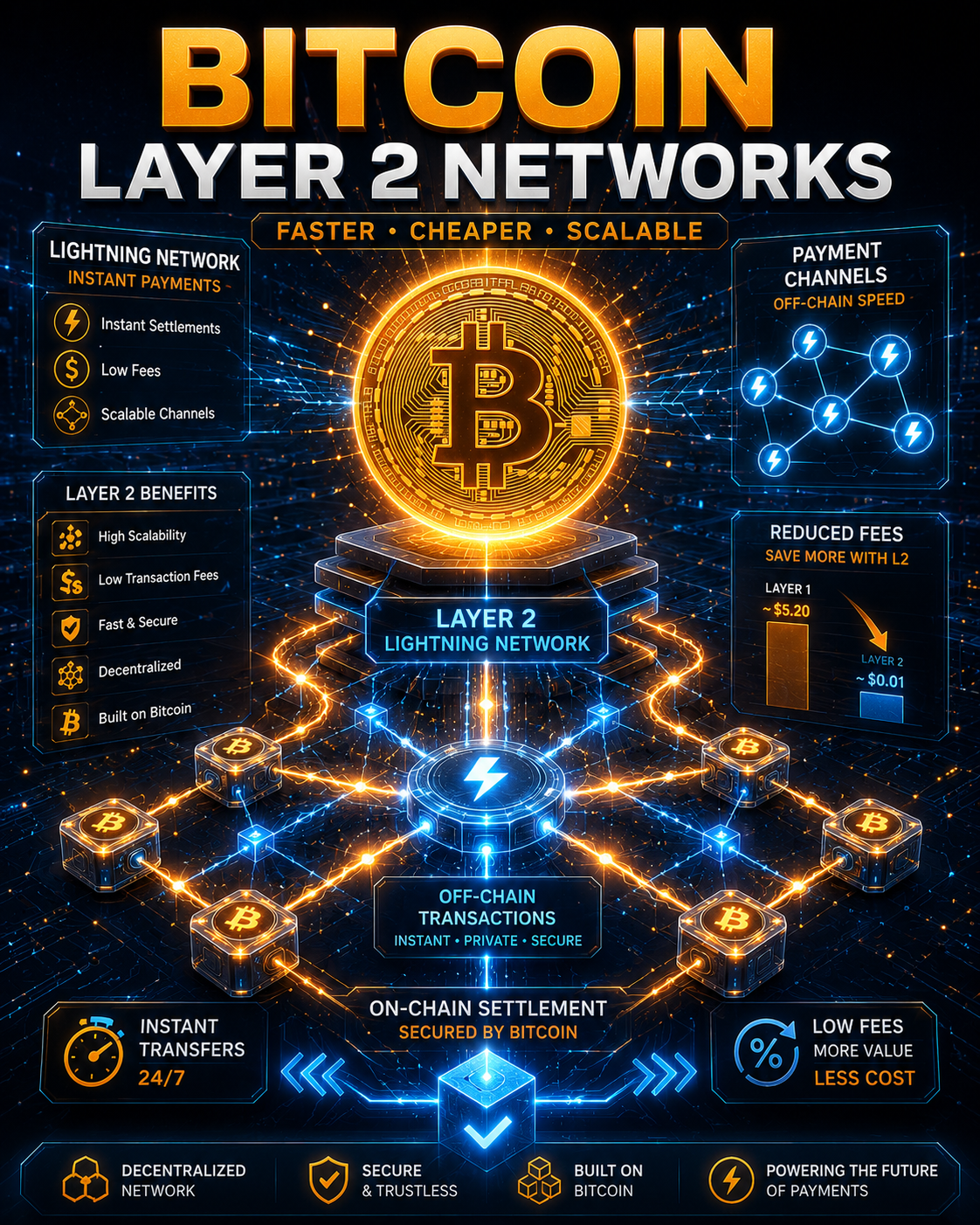
Bitcoin remains the world’s largest cryptocurrency by market capitalization. However, as Bitcoin adoption continues to grow, scalability challenges have become increasingly important. This is where Bitcoin Layer 2 Networks come into the picture.
Bitcoin Layer 2 Networks are designed to improve transaction speed, reduce network congestion, and lower fees without changing Bitcoin’s core blockchain. As a result, these solutions help Bitcoin handle more users and transactions while maintaining security and decentralization.
In this guide, we explain how Bitcoin Layer 2 Networks work, their benefits, leading projects, and why they may play a major role in the future of Bitcoin.
What Are Bitcoin Layer 2 Networks?
Bitcoin Layer 2 Networks are secondary protocols built on top of the Bitcoin blockchain. These networks process transactions outside the main Bitcoin chain while still relying on Bitcoin’s security.
Instead of recording every transaction directly on the blockchain, Layer 2 solutions handle many transactions off-chain and later settle final results on Bitcoin.
Therefore, Bitcoin Layer 2 Networks help improve efficiency without sacrificing the security that makes Bitcoin valuable.
Why Bitcoin Needs Layer 2 Solutions
Bitcoin was designed to prioritize security and decentralization. While this approach has helped Bitcoin become a trusted digital asset, it also limits transaction throughput.
Some common challenges include:
- Slow transaction processing
- Network congestion
- Higher fees during peak demand
- Limited support for complex applications
Consequently, developers have created Bitcoin Layer 2 Networks to solve these issues while preserving Bitcoin’s core principles.
How Bitcoin Layer 2 Networks Work
Bitcoin Layer 2 Networks process transactions away from the main blockchain.
The process generally follows these steps:
1. Open a Secondary Channel
Users create a connection through a Layer 2 protocol.
2. Process Transactions Off-Chain
Transactions occur outside the Bitcoin blockchain.
3. Final Settlement
The final balance is recorded on Bitcoin’s main network.
As a result, users can complete many transactions quickly while reducing blockchain congestion.
Benefits of Bitcoin Layer 2 Networks
Bitcoin Layer 2 Networks offer several important advantages.
Faster Transactions
Transactions can be completed almost instantly.
Lower Fees
Users often pay significantly lower fees compared to on-chain transactions.
Better Scalability
Layer 2 solutions increase the number of transactions Bitcoin can handle.
Improved User Experience
Faster processing creates a smoother experience for payments and applications.
Expanded Use Cases
Developers can build advanced applications using Bitcoin infrastructure.
Therefore, Bitcoin Layer 2 Networks help make Bitcoin more practical for everyday use.
Lightning Network
Lightning Network is currently the most widely adopted Bitcoin Layer 2 solution.
The network uses payment channels that allow users to conduct multiple transactions without recording each one directly on the blockchain.
Once the channel closes, the final balance is settled on Bitcoin.
Key Features
- Near-instant transactions
- Low transaction fees
- High scalability
- Global payment support
Furthermore, Lightning Network is increasingly used for merchant payments and microtransactions.
Stacks
Stacks is another important project within the Bitcoin Layer 2 ecosystem.
Unlike Lightning Network, Stacks focuses on smart contracts and decentralized applications.
Developers can build applications while benefiting from Bitcoin’s security.
Key Features
- Smart contracts
- Decentralized applications
- Bitcoin-secured ecosystem
- Developer-friendly environment
As a result, Stacks expands Bitcoin beyond simple value transfers.
Rootstock (RSK)
Rootstock, often called RSK, brings Ethereum-like smart contract functionality to Bitcoin.
The platform enables developers to build decentralized finance applications connected to Bitcoin.
Key Features
- Smart contract support
- Bitcoin interoperability
- DeFi ecosystem
- Secure infrastructure
Consequently, Rootstock helps bridge the gap between Bitcoin and decentralized finance.
Liquid Network
Liquid Network focuses on faster settlement and asset issuance.
The platform is particularly useful for exchanges, traders, and institutions.
Key Features
- Faster settlements
- Asset tokenization
- Enhanced privacy
- Institutional adoption
Moreover, Liquid Network supports a growing ecosystem of Bitcoin-based assets.
Why Investors Are Watching Bitcoin Layer 2 Networks
Many investors believe Bitcoin Layer 2 Networks could become one of the most important developments in the Bitcoin ecosystem.
Several factors support this view:
- Growing Bitcoin adoption
- Increased demand for faster payments
- Expansion of decentralized applications
- Institutional interest
- Lower transaction costs
Because of these trends, Bitcoin Layer 2 Networks continue to attract developers and investors worldwide.
Risks of Bitcoin Layer 2 Networks
Although Bitcoin Layer 2 Networks offer significant benefits, there are risks to consider.
Common risks include:
- Technical complexity
- Security vulnerabilities
- Regulatory uncertainty
- Adoption challenges
- Network competition
Therefore, users should understand how each protocol works before using it.
Bitcoin Layer 2 Networks and the Future of Web3
Bitcoin has traditionally been viewed as a store of value. However, Bitcoin Layer 2 Networks are expanding its functionality.
Developers can now build:
- Payment systems
- DeFi platforms
- NFT projects
- Gaming applications
- Digital asset marketplaces
As adoption grows, Bitcoin may become a more active participant in the broader Web3 ecosystem.
The Future of Bitcoin Layer 2 Networks
The future appears promising for Bitcoin Layer 2 Networks.
As demand for scalability increases, developers are expected to continue improving Layer 2 technologies. Furthermore, institutions are exploring new ways to integrate Bitcoin into payment and financial systems.
Consequently, Bitcoin Layer 2 Networks could become essential infrastructure for the next phase of blockchain adoption.
Lightning NetworkStacksBitcoinLightning NetworkStacksBitcoin