How Stablecoins Global Payments Are Transforming Finance in 2026
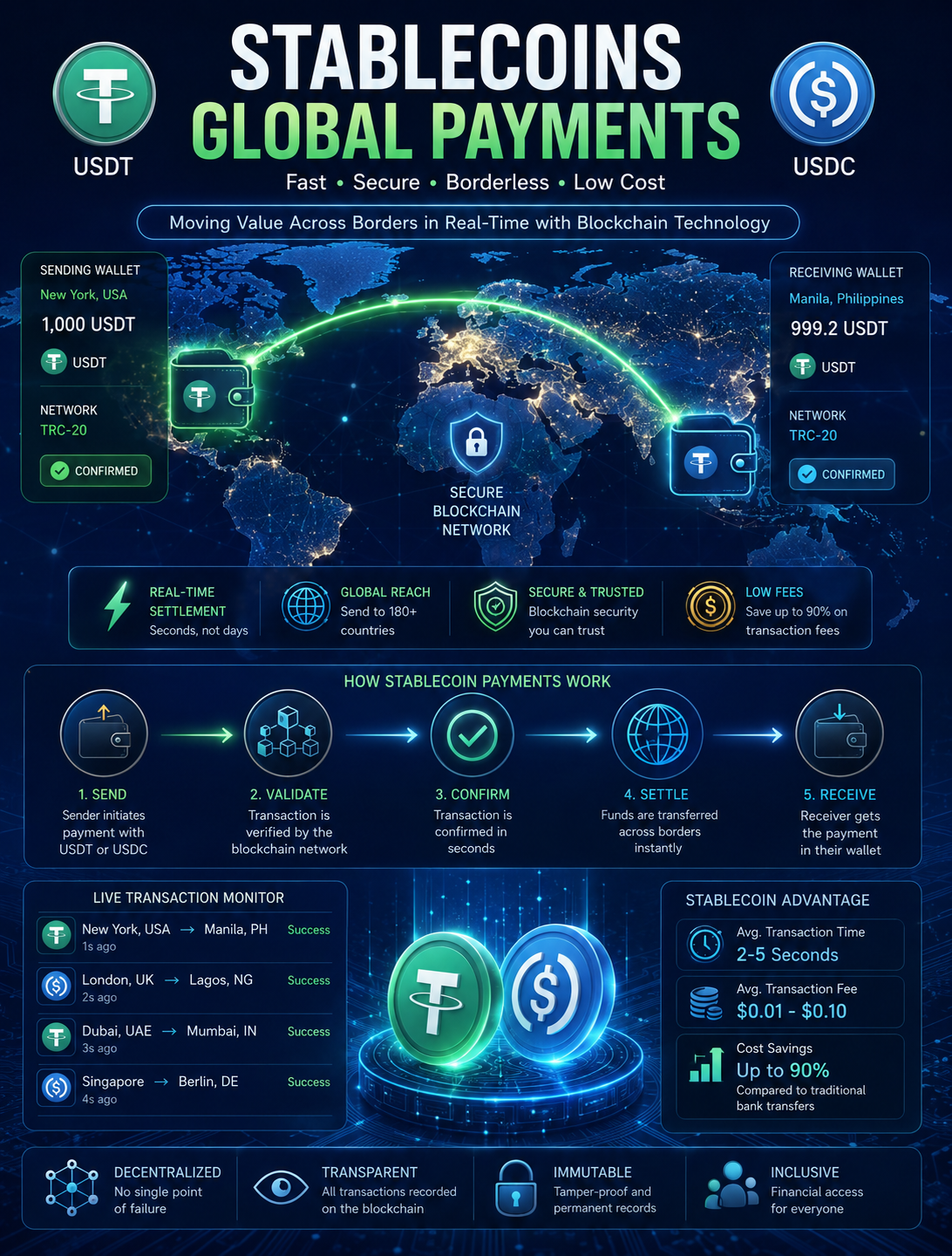
The financial world is changing rapidly as blockchain technology continues to gain adoption. One of the most important developments in recent years is the rise of stablecoins. Today, Stablecoins Global Payments are becoming a practical solution for businesses, individuals, and financial institutions seeking faster and more affordable transactions.
Unlike traditional cryptocurrencies, stablecoins are designed to maintain a stable value by being linked to assets such as the US dollar. As a result, Stablecoins Global Payments provide the benefits of blockchain technology while reducing the volatility commonly associated with cryptocurrencies.
In this guide, we explore how Stablecoins Global Payments work, their advantages, major use cases, risks, and their growing impact on the global financial system.
What Are Stablecoins?
Stablecoins are digital assets designed to maintain a stable price. Most stablecoins are backed by fiat currencies such as the US dollar, while others may be backed by commodities or algorithmic mechanisms.
Popular stablecoins include:
- USDT (Tether)
- USDC (USD Coin)
- DAI
- FDUSD
Because their value remains relatively stable, stablecoins are ideal for payments and financial transactions.
What Are Stablecoins Global Payments?
Stablecoins Global Payments refer to the use of stablecoins for domestic and international money transfers.
Instead of relying on traditional banking networks, users can send stablecoins through blockchain networks. Consequently, transactions can settle faster and often at a lower cost.
Furthermore, Stablecoins Global Payments can operate 24 hours a day, seven days a week, unlike many traditional financial systems.
Why Stablecoins Global Payments Are Growing
Several factors are driving the adoption of Stablecoins Global Payments.
Faster Transactions
Traditional international transfers can take several business days.
However, stablecoin transfers often settle within minutes.
Lower Costs
Cross-border payments frequently involve high fees.
Stablecoins reduce many intermediary costs, making transfers more affordable.
Global Accessibility
Anyone with internet access and a digital wallet can use stablecoins.
Therefore, Stablecoins Global Payments help improve financial inclusion worldwide.
Around-the-Clock Availability
Blockchain networks operate continuously.
As a result, payments can be sent and received at any time.
How Stablecoins Global Payments Work
The process is relatively simple.
Step 1: Acquire Stablecoins
Users purchase stablecoins through exchanges or payment platforms.
Step 2: Transfer Funds
The stablecoins are sent through a blockchain network.
Step 3: Receive Payment
The recipient receives the stablecoins in a compatible wallet.
Step 4: Convert if Necessary
Recipients can hold the stablecoins or convert them into local currency.
Consequently, Stablecoins Global Payments offer flexibility for both senders and receivers.
Benefits of Stablecoins Global Payments
Stablecoins Global Payments provide several significant advantages.
Reduced Transfer Fees
Traditional remittance services often charge substantial fees.
Stablecoins can reduce transaction costs considerably.
Improved Settlement Speed
Transactions settle much faster compared to conventional banking systems.
Enhanced Transparency
Blockchain technology records all transactions on public ledgers.
Therefore, users can verify payment activity more easily.
Better Financial Access
Millions of people lack access to traditional banking services.
Stablecoins help connect these individuals to the digital economy.
Business Efficiency
Companies can streamline international payments and reduce operational costs.
As adoption grows, businesses increasingly explore Stablecoins Global Payments as a practical financial solu
Major Stablecoins Supporting Global Payments
Several stablecoins dominate the market.
USDT (Tether)
USDT remains one of the most widely used stablecoins globally.
Its liquidity makes it popular for payments and trading.
USDC (USD Coin)
USDC focuses on transparency and regulatory compliance.
Many institutions prefer USDC for payment applications.
DAI
DAI is a decentralized stablecoin backed by crypto assets.
It offers an alternative to centrally managed stablecoins.
FDUSD
FDUSD continues gaining adoption as digital payment infrastructure expands.
Each stablecoin serves different users and use cases within the payment ecosystem.
Stablecoins Global Payments and Cross-Border Transfers
Cross-border payments represent one of the largest opportunities for stablecoins.
Traditional international transfers often involve:
- Multiple intermediaries
- High fees
- Delayed settlements
- Currency conversion costs
However, Stablecoins Global Payments simplify this process through blockchain technology.
Consequently, remittances can become faster, cheaper, and more efficient.
Business Adoption of Stablecoins
Businesses increasingly use stablecoins for:
- Supplier payments
- International payroll
- Freelance payments
- Treasury management
- Global commerce
Furthermore, stablecoins reduce friction in international business operations.
As more companies embrace digital assets, Stablecoins Global Payments may become a standard financial tool.
Risks of Stablecoins Global Payments
Although the technology offers many advantages, there are risks to consider.
Some common concerns include:
- Regulatory uncertainty
- Counterparty risk
- Smart contract vulnerabilities
- Market liquidity issues
- Compliance requirements
Therefore, users should carefully evaluate the stablecoins and platforms they choose.
The Future of Stablecoins Global Payments
The future appears promising for Stablecoins Global Payments.
Governments, financial institutions, fintech companies, and blockchain developers continue investing in digital payment infrastructure.
Moreover, improvements in regulation and technology may increase adoption significantly over the coming years.
Many analysts believe stablecoins could become a major component of the global financial system.
As blockchain technology matures, Stablecoins Global Payments may help bridge the gap between traditional finance and digital finance.
How to Choose a Stablecoin for Payments
Before using a stablecoin, consider the following factors:
- Market liquidity
- Regulatory compliance
- Network fees
- Security measures
- Transparency
- Adoption levels
Additionally, users should understand how the stablecoin maintains its value.
Tether (USDT)USDCDAI